
Janus, Roman god of Transition
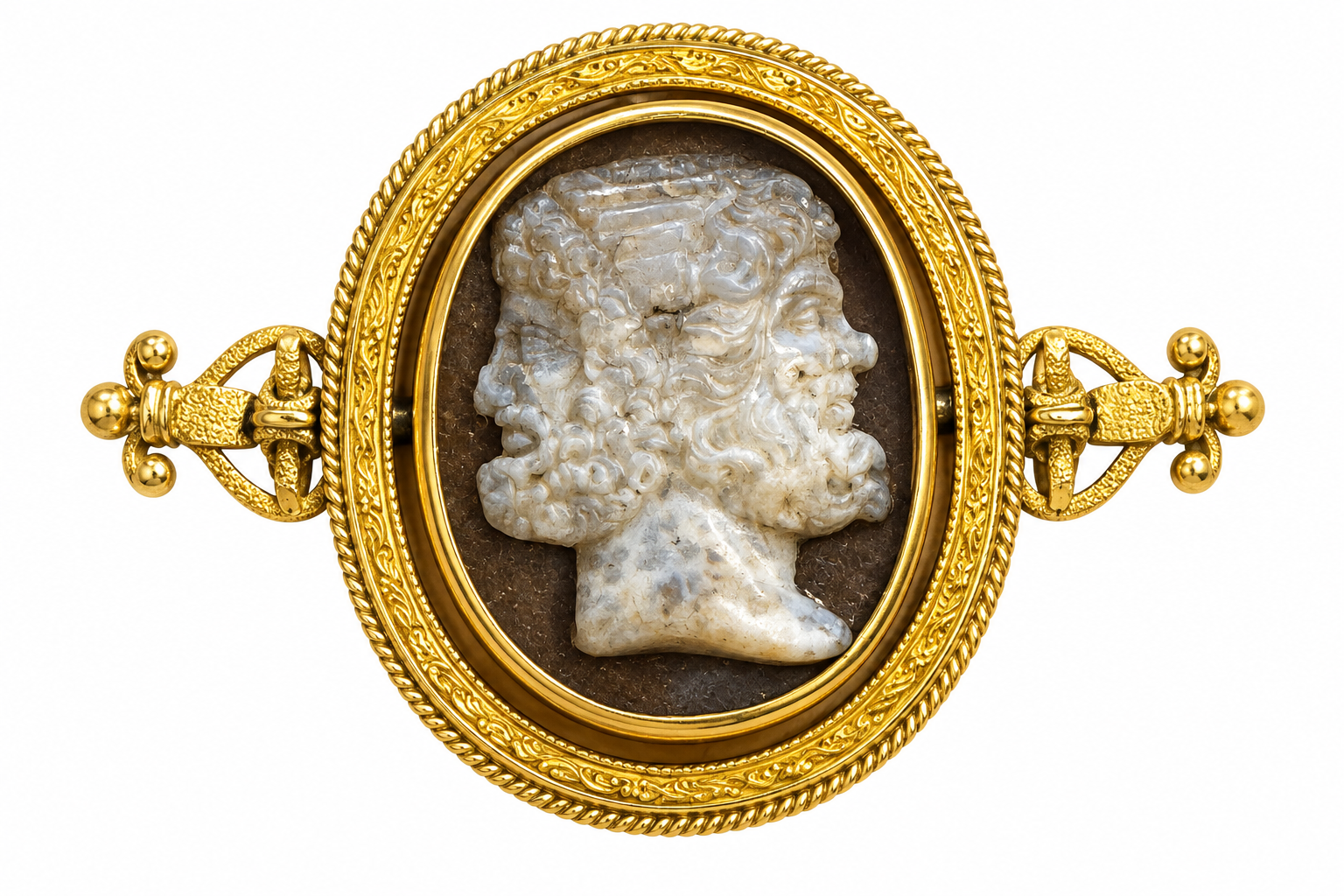
Janus Cameo in Hardstone ca. 1880
Janus: Looking Back, Looking Forward
Some jewels capture beauty. Others capture an idea.
At the centre of this striking nineteenth-century jewel is Janus, one of the most distinctive gods of ancient Rome. Traditionally represented with two faces looking in opposite directions, Janus was the god of beginnings and endings, transitions, doorways and passages.
One face looks towards what has been; the other towards what is yet to come.
His name survives in January, the month that stands at the threshold between one year and the next. For the Romans, Janus presided over moments of change: departures and arrivals, war and peace, the beginnings of journeys and the opening of new chapters.
Here, the double profile is carved in high relief and mounted within an elaborate 18ct gold setting, characteristic of the nineteenth-century fascination with the art and mythology of the ancient world. The sculptural profile sits against a dark ground, dramatically emphasising the pale carving and giving it something of the presence of an ancient cameo or archaeological fragment.
The setting itself deserves attention. A richly worked oval frame surrounds the carving, decorated with delicate foliate ornament and finished with a finely twisted rope border. To either side are beautifully modelled 18ct gold fittings of revivalist character, their symmetrical, almost architectural construction echoing the historicism of the central image.
This was an age in which jewellers repeatedly looked backwards for inspiration. Greek, Roman, Etruscan and Renaissance forms were rediscovered and reinterpreted, and antiquity became something that could be collected — and worn. In this jewel, the 18ct gold setting does not simply hold the carving; it deliberately places it within that nineteenth-century conversation with the ancient past.
Removed from the monumental world of Roman temples, sculpture and architecture and reduced to something intimate enough to be worn, Janus becomes remarkably personal.
Perhaps that is why he remains such a compelling figure. He represents something entirely human: the impossibility of moving forward without carrying some knowledge of what lies behind us.
At Astoria Auctions, we are drawn to jewels such as this because they are more than ornament. They are objects through which mythology, craftsmanship and human experience survive — passed from one age into another.
Janus looks both ways. Perhaps all old jewels do.