
Essex Crystals: Tiny Paintings Beneath Crystal
At first glance, an Essex crystal can appear almost magical. A tiny animal, flower, bird or sporting scene seems to float inside a perfectly polished dome of rock crystal, possessing a depth and animation quite unlike conventional miniature painting.
The secret lies not on the surface, but behind it.
Despite their name, Essex crystals have no particular connection with the English county of Essex. The name arose through a nineteenth-century misunderstanding, when this distinctive form of reverse-carved crystal work became associated with the English artist William Essex. Although Essex was celebrated for his miniature enamels, the technique itself is now generally associated with continental European—particularly Belgian—craftsmanship.
(Caption to be added)
How were they made?
The technique required extraordinary skill.
A piece of clear rock crystal, usually cut as a cabochon, was painstakingly carved in intaglio from the reverse. The resulting recesses were then painted, again from behind, in minute detail. When viewed through the curved front of the crystal, the carving acts almost as a lens.
The result is remarkable: instead of seeing a flat painted image, the eye perceives a miniature three-dimensional subject apparently suspended beneath the surface.
Individual hairs, feathers, eyes and expressions could be rendered on a scale of only a few millimetres. The finest examples possess an almost uncanny sense of life.
A Victorian fascination
Essex crystals became particularly fashionable during the second half of the nineteenth century and continued to be made into the early twentieth century.
They appeared in rings, brooches, pendants, stickpins, cufflinks and buttons. Animals were especially popular. Dogs and horses naturally appealed to Victorian owners, while foxes, game birds and sporting scenes reflected the country pursuits of their owners.
Some pieces depicted a particular beloved animal rather than simply a generic breed. In that sense, an Essex crystal could function almost like a tiny portrait.
Flowers, insects, monograms and maritime subjects were also produced, and increasingly elaborate examples could contain surprisingly complex miniature scenes.
Jewellery with personality
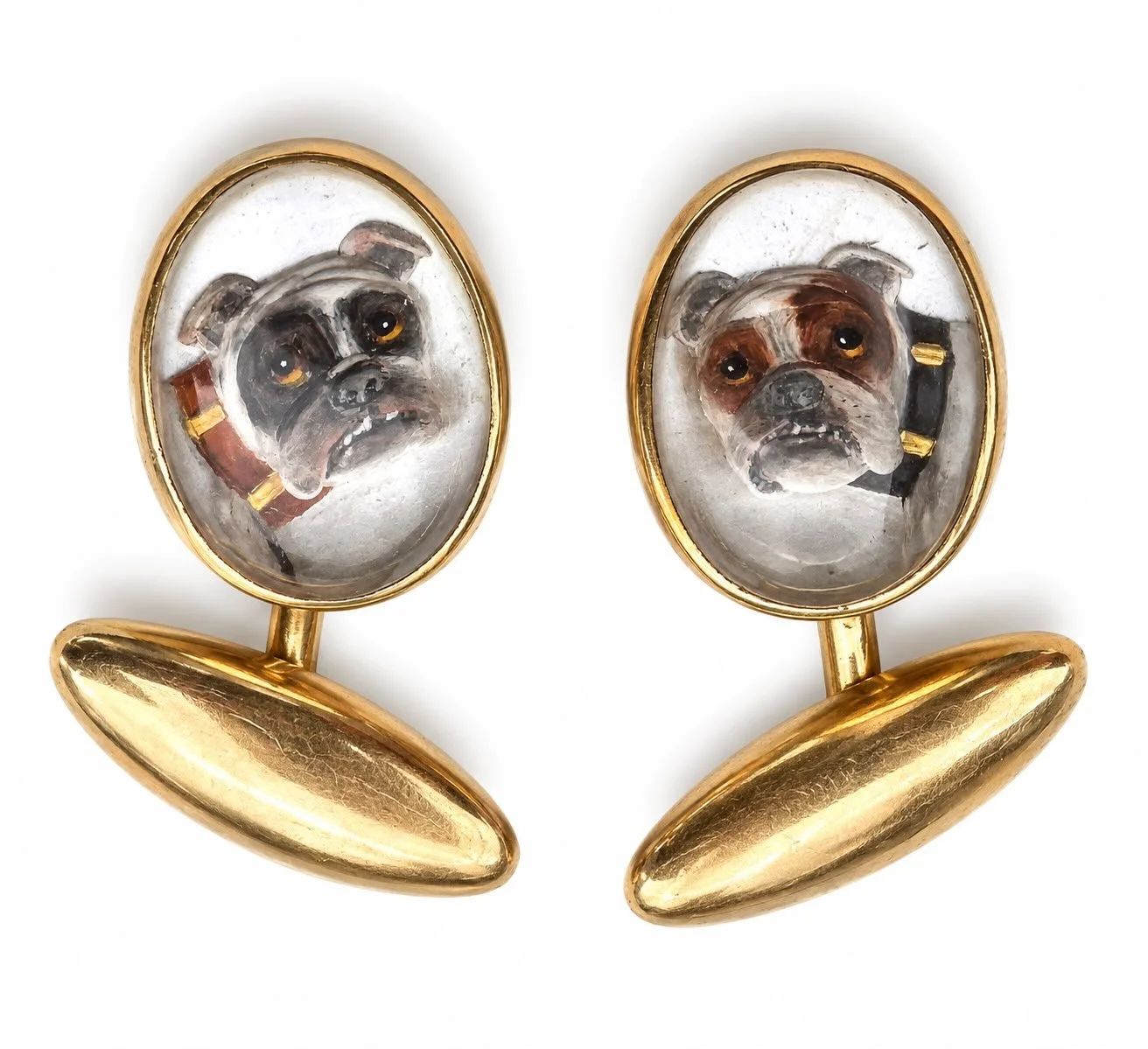
The pair of cufflinks illustrated here demonstrates much of the charm of the technique.
Each oval crystal contains the wonderfully characterful head of a dog wearing a cap, painted beneath the crystal with tiny touches of brown, black, white and red. The curved crystal magnifies the image and gives the face an extraordinary dimensional quality.
Set simply in gold, there is little to distract from the miniature itself. They are amusing without being frivolous and beautifully made without being ostentatious.
They also remind us that nineteenth-century jewellery was not always solemn.
Victorian jewellery could be sentimental, witty and intensely personal. A gentleman’s cufflinks or stickpin offered a discreet opportunity to reveal something about his interests, his humour, his profession—or perhaps an animal he adored.
Why collectors love them
Good Essex crystals occupy an intriguing territory between jewellery, miniature painting and sculpture.
Their appeal lies partly in the difficulty of their manufacture. The artist worked backwards, carving and painting an image that would ultimately be viewed from the opposite side. Mistakes were not easily corrected, and considerable control was required to create convincing depth within such a tiny space.
Condition is consequently important. Damage to the crystal, deterioration of the reverse painting or later restoration can substantially affect both appearance and desirability. Particularly fine early examples with unusual subjects, exceptional detail or identifiable makers can be keenly sought after.
But perhaps their greatest attraction is simpler.
There is something irresistible about picking up an apparently clear jewel and discovering an entire miniature world inside it.
At Astoria, we are drawn to objects like these because they demonstrate something easily forgotten about antique jewellery: preciousness does not always come from the value of the materials alone.
Sometimes it comes from imagination, craftsmanship and the astonishing amount of human skill contained within something small enough to sit upon a cuff.